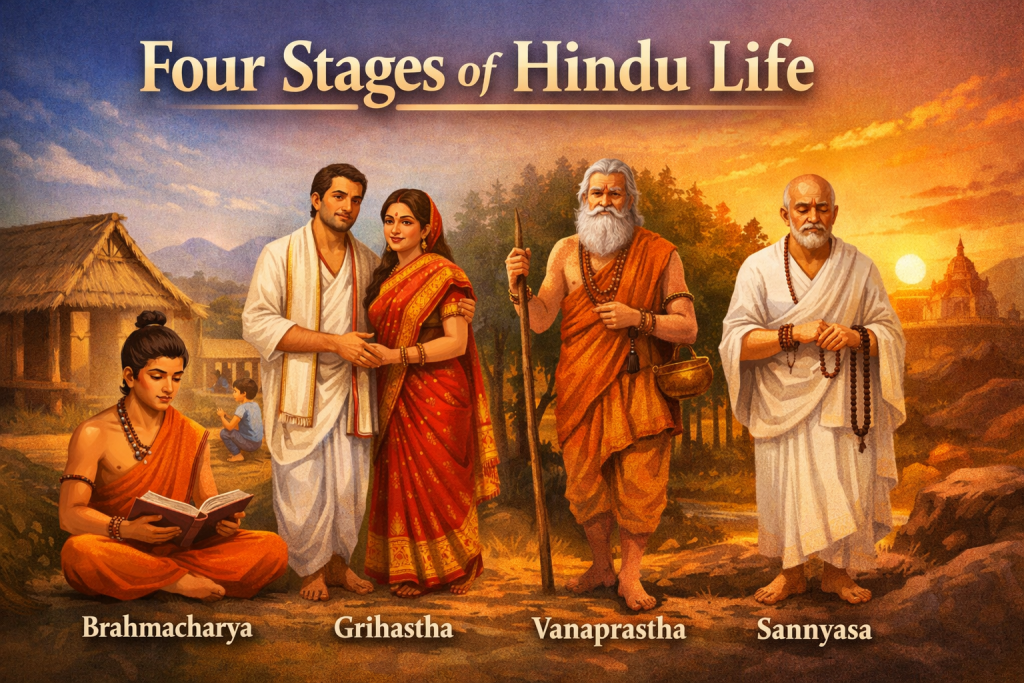
The four stages of Hindu life
Hinduism divides human life into four stages based on an average of 100 years. Each of its tiers is 25 years long and lays down a separate code of conduct for each tier.
Manu says in his Code of Conduct, ‘Now I refer to the code of conduct of a saint. It has four levels. (Each level is called Ashram): Four Stages of Hindu Life
First Stage:
Brahmacharya ashram i.e. time of education and initiation.
Second Stage:
Domestic Ashram i.e. period of family maintenance.
the third Level: ( Four Stages of Hindu Life )
Banaprastha Ashram i.e. period of physical and spiritual cultivation.
The fourth stage: Sannyas Ashram ie Vairagyasadhana Kal.’
Then he added, ‘Among the Chaturashrams, others are supported by the Garhashram. As all rivers flow into the ocean, so does Chaturashram with every domestic ashram. ’52
The rules of conduct for each level are as follows:
One. Brahmacharya Ashram ( Four Stages of Hindu Life )
During this Ashram from the age of eight to 24 years. Important duties for a student at this time are to abstain from the use of perfumes and to avoid external adornment and female company.
Dayananda said, if a student marries during celibacy, it is necessary for him to avoid consorts. He will spend the night alone.”
Manu says that the first thing a student does while in Brahmacharya ashram is to ask his mother, sister, aunt or any woman for something that will not be refused.
During celibacy the student shall take food once a day.**
The student would bow before his guru at the beginning and end of the scriptures. Stand humbly in front of the teacher, as the person offering prayer stands in front of Allah. After this he will ask farewell from the Guru.**
The student will avoid all kinds of delusions. Will spend the night at Gurugriha. Take a bath once a day to make an offering to God. Four Stages of Hindu Life
Drinking alcohol, eating meat, using perfumes, getting company of women and killing animals are prohibited for students. Similarly looking at a woman with lust is also a great sin. By this he will save his semen, even while sleeping. If he ejaculates in spite of this, he should bathe and prostrate for a long time.
The student will find the material he needs from a family that holds Vedic teachings. He will not ask for anything from his special family and Guru’s relatives. Of course, if you don’t get anything from anyone, then you can ask them.
If the student listens to his guru’s blasphemy, he will be born as a donkey in the next life. He who criticizes the Guru will be born as a devil; And one who wastes the Guru’s wealth will be born as an insect. Four Stages of Hindu Life .
It is wrong for a disciple to ride in a car with him, sit on the same bed, sit on a chair in front of him and board a boat in honor of his master.
If the student cannot wake up before sunrise, he will fast that day and perform Suryanamaskar; And if the time of sunset is neglected, then the next day will be fasted. It is extremely wrong to spend the time of sunrise and sunset in sleep and negligence. Because these two times are the time of worshiping the sun.
6 The disciple should stay in the Guru’s presence for 36 years to fully acquire the teachings of the Vedas. If this is not possible, then 18 years; And if that is not possible, then at least 9 years. After that he will enter the domestic ashram.
After describing the code of conduct of the student in the first ashram, Manu says in the last part of the second chapter that the person who follows these code of conduct during the Brahmacharya ashram will have heaven. He will not have to return to earth again.*
So far the code of conduct of the Brahmacharya Ashram, which is mentioned in the Principles of Manu. As described in an Upanishad text, Brahmacharya ashrams for initiation are divided into three levels: Four Stages of Hindu Life.
1. Junior celibacy
: Up to the age of 24 years.
2. Madhya Brahmacharya: It ends at the age of 44.
3. Uttam Brahmacharya: It ends at the age of 84.
Dayanand said, ‘The suitable age for marriage is 40 years. At this age, the latent energy of the body becomes complete. Body parts also become. For the student should take a vow of celibacy till he attains this age.’
Are the timings of Brahmacharya Ashram same for both boys and girls?
In response to this question, Dayananda said, ‘No, the period of Brahmacharya Ashram for girls will be 16 years as opposed to 25 years for boys. Girls will be 17 years against 30 years for boys. Boys will be equal to 36 years and girls will be 18 years. 40 years for boys will be equal to 20 years for girls. 44 years for boys will be equal to 22 years for girls. 48 years for boys will be equal to 24 years for girls. After this the Brahmacharya Ashram will end.***
Indian leader Gambi thinks it better to extend celibacy ashram forever. According to him, ‘Even if they get married, it would be better for them to live like brothers and sisters instead of conjugal behavior.’
Two. Domestic Ashram (Family Life): Four Stages of Hindu Life .
In Hindu society more interest is shown in being a samsarbiriga than in family life. Hindu saints always condemn materialistic life. They encourage their followers to break worldly bonds. Once the Hindu religious people started to feel apprehensive about the evil effect of celibacy in the Hindu society, they started to advocate domestic life. Manu first claimed this Ashram as more prestigious than Chaturashram. He says in his Manusmriti, ‘Garhasthya Ashram is the best of Chaturashrams. ’67
Dayananda says, ‘This domestic ashram of family life paves the way for donations for sadhus and vairagis. If it were not for this family life, there would be no continuation of genealogy on earth. Whoever condemns this ashram, he himself is condemned.’
At this stage of life, Hindus have to get married and make a living for themselves and their spouses.
Three. Banaprastha Ashram (period of physical and spiritual practice)
Manu says,
When a man reaches the end of his age, his hair turns gray, his face becomes wrinkled, and his grandchild is born, he should forsake the worldly life and go to the mountains and forests. He will accompany his wife if necessary; Or leave him with his family. They will meet their food needs with forest fruits and grains. He will wear clothes made of deer skin. Bathe daily. Hair will grow longer. Grow a beard and mustache and don’t cut your fingernails.”
He will not arrange any physical comfort. Will lead a life of celibacy. Abstain from wife-intercourse, even if the wife is with him. Will rest in the shade of the tree. He will spend the night in the trunk of the tree.”
He will abstain from drinking alcohol and eating meat. The diet will be completed by vegetables, flowers, tree fruits and forest grains.”
Eating cultivated grains is a sin for him, even if he is hungry.
He shall eat one day and fast one day; Or one day of fasting and two days of fasting; Or eat for one day and fast for three days.”
He shall lie prostrate on the ground; Or spend the day on tiptoe.”
To subdue and calm the body, one would sit under the scorching sun in extreme heat, get drenched under the open sky in rain, and in wet clothes in severe winter.”
Manu said, ‘Then this third stage of his life will end, which begins at the age of 50 and continues till the age of 75. Only then will he adopt the fourth level.’
Four. Sannyas-Ashram (Vairagyasadhana and Gurukal)
The human child will overcome these levels of his life and enter a new life. This is the time to adopt dispassion and disciple others as gurus. He will be the right guru and follower for people. He will then be above all rules. He will enter the world of status from the material world. Then he will be considered as worshipful as God.
https://www.hinduamerican.org/blog/what-are-the-four-stages-of-hindu-life/
The Sufis say about this position, ‘Hear from Allah and return to Allah.’ It is from this that the Sufis speak of respect for and obedience to their Shaykh, even though his orders are contrary to the Shari’ah
. https://en.wikipedia.org/wiki/%C4%80%C5%9Brama_(stage)
Manu said, ‘At this level people shave their heads, trim their beards and moustaches, cut their nails and carry a bag with them. You will beg once a day.'””
Dayananda said, ‘On reaching this level, he will live like a beggar, giving up all creations, wealth and the illusion of family. Will be engrossed in the pursuit of profound mysteries. There will always be bibhor in penance, by which he will attain nirvana (freedom from repeated births).’
In Sufi terms this is the stage of ‘Fana’ or dissolution.
Pandit Dayananda specified this stage of Vairagya only for Brahmins. Because, they are the best of creation; And dispassion is the best work of mankind. So it will be reserved for Brahmins.